
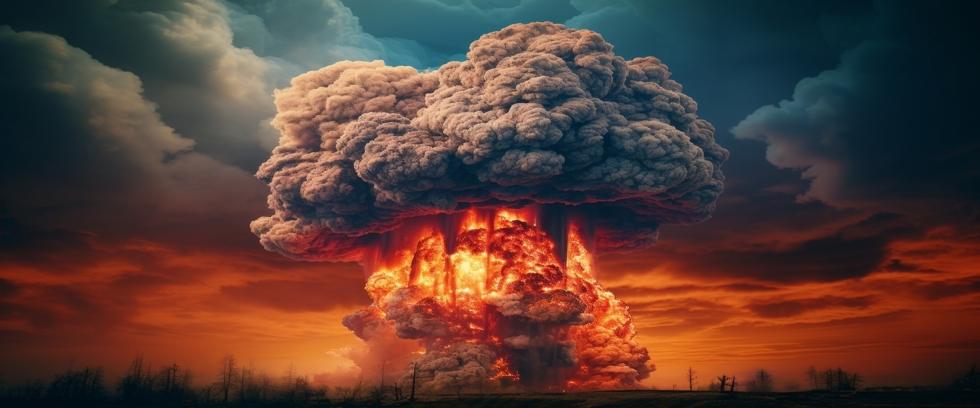
NUCLEAR HOTSPOTS: Where Will Nuclear War Strike First?
Some regions of the world are more likely than others to ignite a nuclear war. Those “nuclear hotspots” are places where long-standing conflicts, nuclear buildups, and aggressive military calculations make the use of nuclear weapons more likely.
Speculating where nuclear war is most probable does not mean predicting the future. It could come as a total surprise. But it does help to understand why some areas of the world are more volatile than others, and what might be done to help stabilize them. Below are several areas where nuclear trouble could strike.
1. Eastern Europe: NATO vs. Russia
The war in Ukraine has already shattered many assumptions about post-Cold War security. During a February 4, 2025, interview with journalist Piers Morgan, Ukrainian President Volodymyr Zelenskyy complained about delays in obtaining NATO membership, requesting instead, “Give us back nuclear arms. Give us missile systems.”
For his part, Russian President Vladimir Putin has repeatedly hinted at the use of nuclear weapons if NATO troops are sent to fight in the war. Putin’s comments have been interpreted by some analysts as strategic posturing, but they still mark a dangerous shift in the way nuclear weapons are discussed – not as measures of last resort, but as acceptable tools of intimidation.
Removing Putin from the picture has been suggested by some, but the consequences of such an extreme action should be carefully considered. Most westerners are surprised to learn that Putin is more moderate than his likely successors would be – some of whom already support using tactical nukes on the Ukrainian battlefield. Not that Putin himself would hesitate to use them if conventional defeat seemed imminent.
With NATO countries hard against Russia’s borders, any misstep—deliberate or accidental—could quickly spiral into a broader conflict involving nuclear weapons.
2. The Korean Peninsula
The standoff between North Korea, South Korea, and the United States is one of the longest-running nuclear confrontations in modern history. Despite consistent diplomatic efforts, North Korea continues to expand its nuclear arsenal and improve its ballistic missile fleet.
North Korea – unlike America, Russia, or China – does not see nuclear deterrence strictly through the lens of Mutually Assured Destruction (MAD). Instead, North Korea’s leadership hinted they may use nuclear weapons in a conventional conflict if necessary. With South Korea’s capital of Seoul just 35 miles from their border, a nuclear strike could kill millions within minutes.
And that’s just for starters. North Korean ICBMs can already attack the Continental US with nuclear warheads, and its new torpedo drones can sail up America’s rivers with weapons heavier than an aircraft can carry.
The Korean Peninsula remains a powder keg, where any misstep could spark a dangerous confrontation. And if trouble ever started, de-escalation opportunities could be limited by the Hermit Kingdom’s paranoid and isolationist nature.
3. India and Pakistan
Few countries in the world display such deep-rooted hatred and animosity as India and Pakistan. Unlike other nuclear-armed nations, India and Pakistan have fought wars over disputed territory for decades. Proximity makes warning times short, and decision times even shorter—conditions ripe for nuclear miscalculation.
One nuclear close call happened in 1999, when Pakistani commandos crossed the Line of Control between Pakistan and disputed Kashmir. India responded with vastly superior conventional forces, completely unaware of satellite images showing that Pakistan’s nuclear weapons were preparing for war. US President Bill Clinton intervened, and Pakistan’s nukes stood down. But it was close, with many analysts believing at one point that the odds of a nuclear war were about even.
In 2001, 2008, and again in 2019, terrorist attacks linked to Pakistani groups pushed India to the brink of major retaliation. Then,a terrorist strike in April 2025 killed 25 Indian tourists, to which India responded with missile attacks inside Pakistan that killed at least thirty. A ceasefire was eventually declared, but tensions remain at a boiling point, and nuclear weapons are still in the picture.
4. Israel…
No country in the Middle East admits to possessing nuclear weapons, but everyone knows that Israel has dozens of nuclear warheads for use on missiles and aircraft. Israel even has a second-strike, strategic submarine fleet.
Dolphins were part of the pennance Germany paid to Israel for atrocities committed upon Jews during WWII – German-built, Dolphin-class, strategic missile submarines. Patrolling beneath the Red Sea, the Persian Gulf, and the Indian Ocean – Dolphins are a powerful deterrent for a country of Israel’s size. Utilizing a silent propulsion system called ‘fuel-cell technology,’ Dolphin’s can stay submerged for weeks, invisible to sonar.
Dolphins employ sound-deadening materials on their hulls, with advanced electronic countermeasures to mask magnetic and infrared signatures. But more important is what’s inside the large 25.5” diameter torpedo tubes. Genuine secrecy shrouds Israel’s Popeye Turbo Submarine-launched Cruise Missile (SLCM), but analysts estimate it can strike targets 1,000 miles away with a 200 kiloton thermonuclear warhead. Such a capability would place Moscow within range of Dolphins near their home base of Haifa in the Aegean Sea.
…and Iran…
By not admitting they have any nukes, Israel avoids some criticism for actually having them. On the other hand, Iran must publicly deny interest in nuclear weapons lest it suffer more airstrikes. However, Iran’s uranium enrichment activities tell a story that cannot be hidden – a story where enrichment level versus time is not a linear scale.
Enriching uranium refers to increasing the percentage of the uranium isotope called ‘U235,’ compared to the far more common isotope ‘U238.’ For example, it takes a certain amount of time in any system to enrich a given sample of uranium from its natural U235 concentration of 0.07% up to 7% – a ten times increase in concentration.
But another 10X increase from 7% to 70% takes far less time because the large volume of U238 already rejected does not need to be processed again. Jigsaw puzzles follow a similar pattern. Each piece is important, but the last pieces fall into place much faster than the first pieces do.
Of relevance is a February 2023 incident, where UN inspectors found particles of 83.7% enriched uranium inside advanced IR-6 centrifuges at Iran’s Fordow enrichment complex. Iran explained how “unintended fluctuations” may have occurred during a “transition period.” But that makes no sense on the face of it, and also leads to the next question: Where did the bulk of that 83.7% enriched uranium go?
Uranium enriched to 83.7% is already usable for nuclear weapons. Just ask citizens of Hiroshima, Japan, where an atomic bomb containing 80% enriched uranium was dropped on their ancestors in 1945.
…and the Middle East…
Israel won’t say it, Iran denies it, yet some countries may be overlooked.
Saudi Arabia does not appear to have a nuclear weapons program, but what if they bought finished nukes from their friend and neighbor, Pakistan? After all, Saudi Arabia financed Pakistan’s nuclear weapons program in the beginning, and still supports it today.
But secret deal or no, Saudi Arabia probably plans to be nuclear-armed eventually. Its long-range ballistic missile program is too suspicious. Missiles like that are usually built for nuclear warheads, where the damage they do is worth the money they cost. And yet, the big missiles may not be meant for warheads from Pakistan after all.
In 2019, Saudi Arabia’s new energy minister announced that they would mine and refine their own uranium for the nuclear power plants they were preparing to build. The minister stated, “If Iran develops a nuclear bomb, we will follow suit as soon as possible.” To back it up, a uranium refinery is already under construction in Western Saudi Arabia.
The warning signs are there, but Saudi Arabia is not the only country that may go nuclear in the region. Turkish President Recep Tayyip Erdoğan’s decision to purchase advanced Russian S-400 anti-aircraft systems was matched by heightened nuclear cooperation as well.
Included is a $20 billion nuclear power complex under construction in Southern Turkey by Russia’s giant energy firm, ROSATOM. Of course, seeking nuclear power is not the same as seeking nuclear weapons. But in this case, Turkey is seizing control over operations in such a way that the construction of nuclear weapons might be accomplished with low accountability.
Perhaps most telling is President Erdogan’s statement in October 2019, “Some nations have missiles with nuclear warheads, not just one or two. But (they say) I should not have missiles with nuclear warheads. I don’t accept this.”
Egypt is another technologically advanced nation that could easily go nuclear. Others may as well. How many nuclear-armed nations are too many in a volatile region like the Middle East?
…and Beyond
Many countries have straddled the nuclear fence.
***Shigeru Ishiba became the Japanese Prime Minister in October 2024. As a former Defense Minister, Mr. Shigeru suggested Japan should develop technology to build nuclear weapons – just in case.
Although an official program does not exist, Japan does possess the technology to go nuclear fast. Is it merely a coincidence that the Roku Nuclear Fuel Reprocessing Facility will go online soon – a plant that can separate eight tons of plutonium per year?
***In 2004, UN inspectors discovered that South Korea had enriched uranium and separated plutonium, which it did not report to the United Nations – a serious violation of the rules. But South Korea is a US ally, so the George W. Bush administration suppressed the information.
But a question was never publicly answered: What was South Korea planning to do with that nuclear bomb building material it was hiding? Such actions suggest that many nations may have nuclear calculations in mind, but are reluctant to speak out about it.
***Moreover, the potential for nuclear escalation does not rest solely with state actors. Non-state groups might acquire enough spent reactor fuel to construct ‘dirty bombs’ that can devastate cities. And worse, the knowledge required to build standard plutonium bombs is no longer a secret. All things considered, we’re lucky we’re still alive with our civilization intact.
Beyond Geography: The Role of Miscalculation
Even if luck holds, and more generations can avoid suffering a deliberate nuclear war, history reminds us that accidents, false alarms, and misjudgments can come by surprise – and end just as quickly.
Modern technology brings new threats along with new promises. Improvements in AI make cyberattacks on nuclear command systems seem increasingly possible. Deepfakes look too much like the real thing. But not being sure what to trust is just one factor in such a context. Trusting the systems and assumptions that underpin nuclear stability may be even more dangerous.
What We Do Next Matters
Identifying nuclear hotspots isn’t about sowing fear. It’s about overcoming fears through recognizing legitimate threats. Only then can we face our fears rationally.
The threat of nuclear war can feel abstract and distant, but the spark that threatens everyone could come from any one of these nuclear hotspots. Conflict doesn’t start with mushroom clouds, but with distrust, miscommunication, and high-stakes brinkmanship.
At Our Planet Project Foundation, we believe that raising awareness is the first step toward action. Nuclear risks are not inevitable. People made them. People can unmake them.
0 Comments