
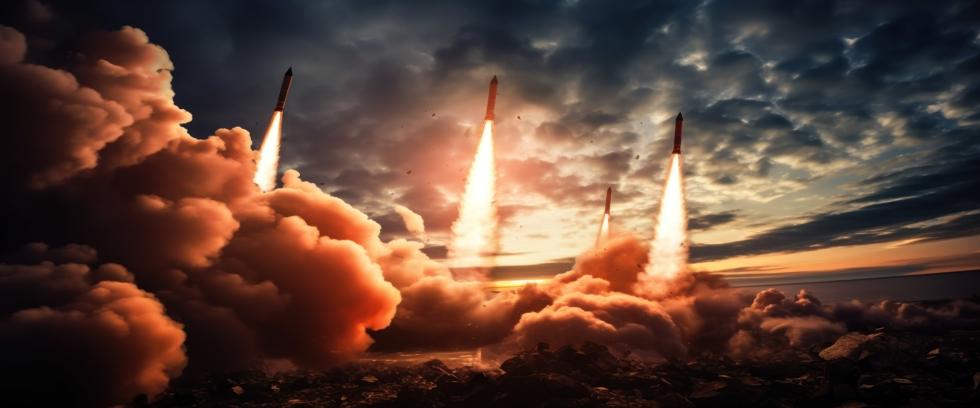
BY THE SKIN OF OUR TEETH: The Fallacy of Mutually Assured Destruction
Humanity has always believed that life could be saved by threatening death. It actually makes sense up to a point. Some nations, and some people, must be forcibly deterred from aggressive action.
But the Cold War doctrine of Mutually Assured Destruction (MAD) took deterrence to another level. Even the name conjures up images of insanity when you think about it. Self-defense could always be violent, but never before could it destroy our civilization.
MAD proposed that nuclear parity would make America and the Soviet Union behave themselves. A nuclear strike would be met by a nuclear strike in return. But it was a fragile assumption, hanging on the belief that rational leaders, clear communications, and perfect control would always prevail.
History differs. Instead, we narrowly escaped a terrible tragedy on several occasions – not because of MAD, but because of individual action that sometimes went against official protocol. And because of luck. As one senior Cold War analyst concluded, “We survived by the skin of our teeth.”
But he didn’t mention that the threat is not over while nuclear weapons still remain.
SAD
MAD has a sister acronym called SAD. Self Assured Destruction is not as well known as MAD, but it is worse in some respects. SAD accounts for the nuclear winter that your own weapons will create if you nuke your enemy. A nuclear winter that will kill you as well – even if the other side does nothing!
Nuclear winter is covered in a previous post, but suffice it to say it is the ultimate consequence of nuclear war. A US/Russia nuclear war would produce a nuclear winter that killed far more people than blast, fire, radiation, and fallout combined.
The Fragility of Deterrence
MAD assumes all actors are rational, stable, and committed to restraint. But history shows that leaders are not always rational, and governments change as ideologies shift.
Deterrence may evaporate if one side believes it has gained an advantage through missile defense systems, tactical nuclear weapons, or cyber capabilities. It was never reliable, but the doctrine of MAD becomes extremely unstable when false assumptions cause irrational behavior.
Yet perhaps more troubling is how little attention is paid to accidents and close calls. This is an uncomfortable subject for military officials, but declassified reports reveal many accidents and near misses – some truly terrifying considering the existential stakes.
The fatal flaw in MAD has been thoroughly exposed. The doctrine demands perfection when perfection is unattainable.
The following are five times when MAD failed. Times when individual action kept the world from becoming something unrecognizable. Most people have heard of the Cuban Missile Crisis, but it would only rank seventh or eighth on a top-ten list. It was frightening enough, but the nuclear arsenals of America and Russia had grown much larger by the time these later incidents occurred.
Stanislav Petrov
The night was cool for late September, but Moscow was no stranger to early winters. Watching the clock pass midnight, Lieutenant Colonel Stanislav Petrov wasn’t concerned about it. It was comfortably warm inside the Soviet nuclear early warning command center where Petrov worked as duty officer.
But suddenly all hell broke loose. Multiple piercing alarms sounded. Petrov jerked to attention, barking orders and asking questions. The answers he received were incredible. Over thirty systems reliability checks all agreed: America had launched a ballistic missile attack against the Soviet Union.
Colonel Petrov’s duty was clear. The attack was confirmed. Before him was a hot-line telephone to his superior officers. Petrov reached for it, then hesitated. Military protocol was also clear, and called for an immediate, all-out counterstrike upon confirmed warning. But what if the warning was wrong?
Petrov knew such questions were not his to ask. He was a soldier who was already disobeying orders by hesitating. But he couldn’t make himself pick up the phone. Colonel Petrov was a career officer who knew all too well what would happen if he did. It was later revealed that a nuclear early-warning satellite had mistakenly identified sunlight reflecting off clouds as incoming missiles.
The incident remained secret until after the Soviet Union fell and classified files became publicly available. Bruce Blair was a strategist with the Center for Defense Information at the time. When later questioned about the event he stated, “Soviet top leadership, given minutes to decide, and told an attack had been launched, would have made the decision to retaliate.” Most authorities on both sides of the Atlantic agree. It was almost WWIII, and only a few people even knew about it.
Everyone on Earth should be thankful that Stanislav Petrov ignored his duty forty-two years ago. We probably owe him our lives. What if an officer who followed orders had been working that night?
The Training Tape Scare
Picture yourself in the room: A training program meant to simulate a Soviet missile attack is accidentally loaded onto a nuclear early warning computer at North American Aerospace Defense Command. NORAD’s system responds as it should, indicating hundreds of incoming ICBMs.
But the computer was electronically connected to other military command centers, causing them to “independently” register the attack as well. To personnel on duty it was the real thing. Nuclear strategic bombers made ready for war. ICBMs prepared to launch. Senator Charles Percy was touring NORAD at the time, and later testified before Congress how the atmosphere in the room was, ”…absolute panic.”
They weren’t the only ones. A call from NORAD Headquarters woke the secretary of defense in the middle of the night. America was under attack by Soviet ICBMs. The secretary prepared to inform the president, knowing just minutes remained before the White House was destroyed. Then his phone rang again. The attack was confirmed. Hundreds of missiles were minutes away.
But then someone realized the missiles were not registering on radar. Someone else noticed striking similarities between the current attack and a training program they had recently completed. Too many similarities to be a coincidence. Those were our unsung heroes right there.
A false alarm was eventually declared and the nukes stood down. But it was close. How close? No one can say. But the gravity of the situation speaks for itself when civilization-ending ballistic missiles were ready to launch on a moment’s notice.
What if word of the “confirmed” attack had reached the president in time to order a nuclear counterstrike? That could have happened. We’re lucky it didn’t.
The 46-cent Computer Chip
Procedures were changed. The system was declared trustworthy and reliable again.
But a year later, a nuclear early warning satellite registered two ballistic missiles streaking toward America from the Atlantic Ocean. Then more missiles were detected coming from the same area. A third alert warned that ICBMs had been launched at America from the Soviet mainland itself. Independent systems at the National Military Command Center confirmed the attacks were real.
US nuclear forces again went on high alert. Ballistic missiles prepared to launch. But no sooner were the preparations completed, than the alerts suddenly ended. Heartbeats returned to normal. Yet investigators found nothing wrong with the system until it happened again a few months later.
The false alarms were eventually traced to an intermittently failing 46-cent computer chip. The chip was replaced and the system declared trustworthy and reliable. Again. But the hair-raising nature of those events speak for themselves. Stanislav Petrov must have known the feeling.
Able Archer 83
No one can say, but the scariest of past squeakers may have happened during a Cold War military exercise called Operation Able Archer. The NATO exercise was designed to simulate military maneuvers leading up to a nuclear war, but the Soviets mistook the maneuvers for real ones instead.
Everything about Able Archer looked exactly like what the Russians would expect to see just before suffering a nuclear strike. Even their spies in America were reporting unusual military activity.
Soviet nuclear forces went on high alert. Su-24 strategic bombers flew to forward bases armed with megaton-sized thermonuclear weapons. Nuclear artillery pieces moved to frontline positions for the very first time.
Soviet leader Yuri Andrapov sent a letter to party officials stating, “The Motherland was truly in danger and there was no chance for improvement in relations with the United States.” Most of Andrapov’s generals wanted to strike the US immediately, fearing that American ICBMs would destroy their missiles before they could launch.
But it was all a misunderstanding. A nuclear misunderstanding. The incident is detailed in top-secret documents recently declassified by the National Security Archive – and by investigator Nate Jones who tells the story in his book Able Archer 83. Information can also be found at nsarchive.gwu.edu under the Able Archer war scare.
Once again, minor characters may have saved our civilization. One was a front-line NATO commander, Lieutenant General Leonard H. Perroots. General Peroots found himself in a difficult position watching the Soviet nuclear buildup. His training called for matching escalation with counter-escalation, but instead he did nothing at a time which, in retrospect, nuclear war may have hung in the balance.
Both sides were armed to the nuclear teeth. The Soviets were teetering perilously close to a nuclear first strike. An aggressive move by Perroots could have ended civilization and thrown humanity back to the Dark Ages for decades, if not centuries.
All of which raises the same question as the Stanislav Petrov affair: What if an officer who followed procedure was commanding at the time?
A British double-agent named Oleg Gordievsky realized what the Soviets were thinking and let his superiors know. The information was passed to the United States, and President Regan was informed. Many CIA analysts refused to believe it but the President was not so sure. Regan ordered that steps be taken to assure the Soviets he had no plans to attack them with anything.
Of interest is a comment by Tom Blanton in the Forward to Mr. Jones’ book: “Perhaps the most chilling of all are the documents showing how the Able Archer exercise ramped up right into pretend nuclear war in a matter of days, when ‘Blue’s use of nuclear weapons did not stop Orange’s aggression.’ This is the way the world ends.”
Although the world cannot end that way with our current nuclear arsenals, isn’t it bad enough that our civilization and the life of nearly every human being on Earth can?
The Norwegian Rocket Incident
Not all close-calls with nuclear weapons happened during the Cold War. One of the most frightening was the Norwegian Rocket Incident.
In 1995, American and Norwegian scientists launched a rocket from the Norwegian Coast to study the Northern Lights. Nothing unusual, except its course resembled one that a ballistic missile would take if launched at Russia from a US Trident submarine in the Barents Sea.
The Soviet Union was history and so was the Cold War. Tensions between America and Russia were at the lowest point since they were allies during WWII. But once again, Russian nuclear forces went on high alert. To early-warning radar operators, the rocket’s stage-separation matched the profile that a nuclear-armed D5 missile would exhibit.
It was just one rocket, but a nuclear war would likely start by detonating a specialized warhead at high altitude to generate an electromagnetic pulse (EMP). A powerful EMP can damage electronic systems, blinding satellites and radars to the main strike.
Russian President Boris Yeltsin immediately activated his mobile nuclear command center. Poised to strike, Yeltsin was told he had ten minutes until impact to decide. Eight minutes passed before a false alarm was declared.
Yeltsin stood down, but another hair-raiser was added to the list. Two minutes! Talk about rolling the nuclear dice. And Yeltsin was a chronic drunk whose mornings usually featured Russia’s best-known alcoholic beverage. He was probably drunk when the incident occurred.
A drunk with his fingers on a nuclear doomsday keyboard. We can’t go on this way.
A Doctrine Without a Time
MAD was never reliable, but today’s multipolar nuclear world has rendered it outdated to the point of irrelevance. It was largely a US-Soviet nuclear standoff during the Cold War, but nine independently-minded nations possess nuclear arsenals today. Believing that MAD can reliably accommodate so many ideologically opposed actors stretches logic beyond reason. Especially when MAD failed on numerous occasions with just two parties involved.
Emerging technologies further undermine MAD’s effectiveness. Cyberwar threatens early warning systems, or simulates false attacks. Hypersonic missiles reduce decision times from minutes to seconds. Artificial intelligence, increasingly integrated into military systems, makes life-or-death decisions with mathematical algorithms. Each new development weakens the promise of reliable retaliation upon which MAD depends.
The Real Danger of Believing the Myth
The greatest danger of Mutually Assured Destruction may actually be the false sense of security it provides. The incidents we know about were terrifying enough, but who knows what close calls have happened the public knows nothing about? Yet as long as MAD is considered a reliable safeguard, governments may feel justified in retaining or modernizing their nuclear arsenals. Continued reliance on MAD perpetuates an arms race camouflaged as stability.
This is not stability. It is gambling with the future of humanity and the planet we live on. To rely on MAD is to acknowledge that catastrophe is inevitable. But nuclear weapons are not safety nets or insurance policies. They are triggers waiting to be pulled.
The Path Forward
At Our Planet Project Foundation, we believe Mutually Assured Destruction is a false doctrine that history has convincingly debunked. Terrifying close-calls that we managed to escape in the past – often without our knowledge at the time – would have ended in tragedy had our luck run out. Sooner or later it always does.
Every day we cling to MAD is another day living a lie. It’s time we end this dangerous MADness that was flawed from the start and replace it with the security of a nuclear-free world.
0 Comments