
The Power of Nuclear Weapons: What a Single Trident Submarine Could Do
What Is a Trident Submarine?
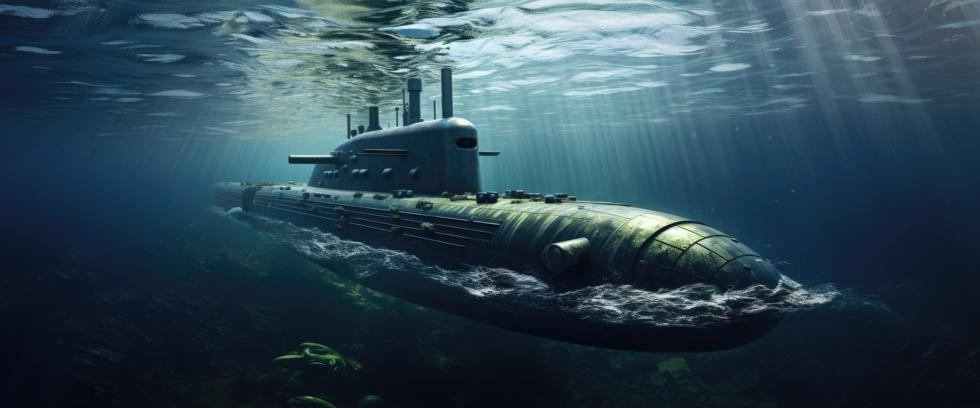
Trident submarines, also called Ohio-class submarines, are the sea-based leg of America’s strategic nuclear triad. The other two legs are nuclear strategic bombers and land-based ICBMs. The US Navy currently operates fourteen Trident submarines, with a minimum of four always at sea, prepared to strike on the president’s command.
Trident’s are nuclear-powered, and can travel half a million miles at depths of 1,000 feet without refueling. Each submarine has 20 launch tubes containing a Trident II D5 missile. The missiles have a range of 7,500 miles and may hold up to eight W88 thermonuclear warheads that can each strike a separate target.
Unthinkable Destruction
A W88 warhead yields about 475 kilotons, or the explosive power of 475,000 tons of TNT. So, a D5 missile with eight warheads, multiplied by 475 kilotons per warhead, totals 3.8 megatons per missile – a megaton equaling a million tons. Which means that a Trident submarine with twenty D5 missiles can carry more than 75 megatons of thermonuclear firepower.
For reference, the atomic bomb that flattened Hiroshima, Japan, during WWII yielded about 15 kilotons. So, a Trident submarine loaded with W88 warheads equals the power of more than 5,000 Hiroshima bombs. And with fourteen submarines in the Navy, the Ohio-class fleet can be armed with the equivalent of more than 70,000 bombs like the one that destroyed Hiroshima.
NUKEMAP: Another Way of Looking at It
There is an internet app called NUKEMAP, where the damage caused by nuclear warheads is simulated. By selecting a city and a warhead size, the effects on a target can be seen.
If 475 kilotons is entered – the approximate yield of a W88 warhead – and the ‘airblast’ option is selected, then NUKEMAP estimates that buildings will be damaged throughout an area about 20 miles in diameter. Another factor involves 3rd degree burns, which are predicted in an area about 18 kilometers in diameter. Finally, increasing those numbers by a factor of eight reveals what a D5 missile with W88 warheads could do.
It is commonly believed that the Hiroshima bomb killed about 150,000 people. But recent estimates by the City of Hiroshima and the US Department of Energy place the number closer to 225,000. However, since every D5 missile is probably not loaded to the maximum, this analysis uses the more conservative number of 150,000 to compensate.
All of which leads to an astonishing conclusion: If the Hiroshima bomb killed 150,000 people with 15 kilotons, and America’s Ohio-class fleet can be armed with the equivalent of 70,000 Hiroshima bombs, then Trident submarines alone could kill over 10 billion people, or more than the population of the planet Earth.
Of course, mitigating factors come into play, like the existence of smaller cities not hit directly by warheads. But aggravating factors such as fatalities from fallout and nuclear winter must also be considered.
The Big Radius Tool
Another internet app called The Big Radius Tool helps clarify the picture. With the app, the population within a given radius of a selected city can be found. The default radius is 25 miles.
Since the power of W88 warheads is about equal to 32 Hiroshima bombs, the power of eight warheads is equivalent to 250 Hiroshima bombs. That much nuclear firepower could devastate everything within 25 miles of ground zero.
The Bottom Line
A Trident submarine with twenty D5 missiles could strike twenty American cities with eight warheads each. Of course, Trident submarines would not attack American cities. But most people reading this are probably more familiar with America than with Russia, so America is used as an example instead. This analysis is only meant to show what a single boat could do.
One Trident submarine could do this:
13 million dead within 25 miles of Manhattan
13 million dead in the Los Angeles area
9 million dead around Chicago
8 million dead near Dallas-Ft. Worth
22 million total dead near Houston, Philadelphia, San Francisco, Boston, and Atlanta
18 million total dead near Seattle, Minneapolis, Detroit, and Washington D. C.
12 million total dead near Denver, Baltimore, St. Louis, and Tampa-St. Petersburg
10 million dead near San Diego, Kansas City, and Phoenix
That’s over 100 million Americans killed instantly before fire, radiation, and fallout took their toll. Then comes nuclear winter to finish the job.
But frightening as they are, those numbers are not complete. They fail to account for the rest of America’s Trident fleet, Russian ballistic missile submarines, American and Russian ICBMs, and nuclear strategic bombers, or the nuclear arsenals of other nations.
A Dangerous Paradox
Supporters of Trident and similar systems claim that their very existence prevents war. But such reasoning is delusional at best. In order for nuclear deterrence to work, nations must build and maintain terrible weapons that can never be used for fear of their own annihilation. Weapons that rely on complex technologies are subject to failure.
Nuclear deterrence ignores the fact that people make mistakes and accidents inevitably occur. Miscommunication, misinterpretation, and cyberattacks could also bring unintended consequences – consequences that may mean the destruction of our civilization and the demise of nearly every person on Earth.
The longer nuclear weapons exist, the more chances there are for deterrence to fail. Reason and common sense tell us that. The mathematical law of probability demands it.
Toward a Safer Future
At Our Planet Project Foundation, we believe that logical analysis of nuclear realities fosters greater awareness of the risks that nuclear weapons entail. Risks that cannot be eliminated through human effort or technological innovation, no matter how hard we try. Instead, we understand that those risks can only be eliminated by abolishing nuclear weapons entirely.
0 Comments